
5 Signs a Tree on Your Spring TX Property Is More Dangerous Than It Looks After a Storm

July 14, 2026

Share this article

The storm is over. The skies have cleared. You walk outside, scan your yard, and the trees are still standing. Most homeowners stop right there and consider the situation resolved.


That assumption is where the real danger begins.


After severe weather moves through Spring, The Woodlands, Tomball, Cypress, and the surrounding North Houston area, some of the most hazardous trees are the ones still upright. A tree does not have to fall during a storm to become a threat. Internal cracks, compromised root systems, and hidden canopy damage can turn a tree that looks fine from the street into a liability that fails days or weeks later, often without warning.


Bill Beal's Bonded Tree Service has been removing and inspecting storm-damaged trees across Harris County for over 40 years. These are the five signs the team sees most consistently in the properties where homeowners waited too long.

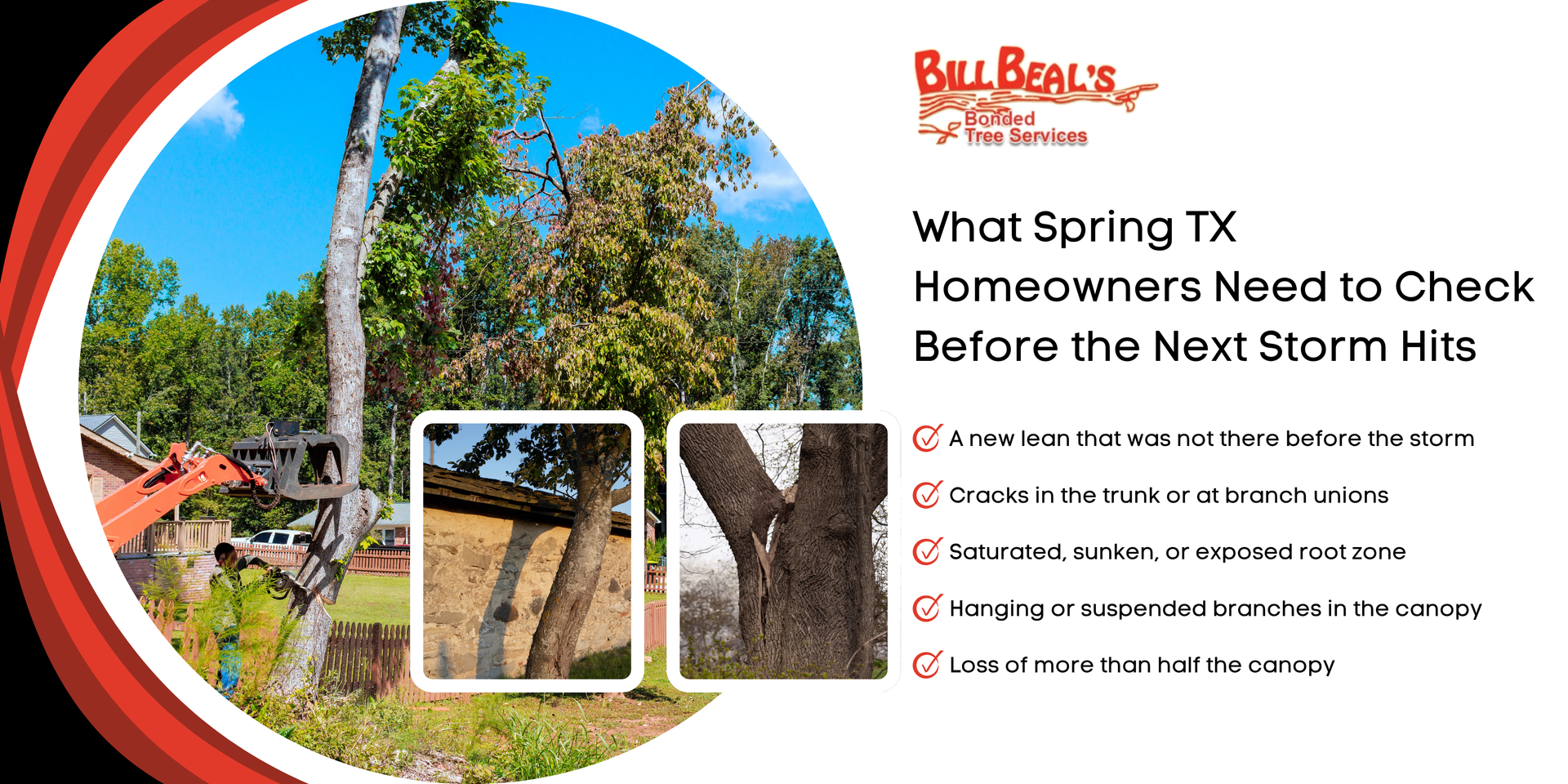
Spring storm home checklist flyer with trees, roof damage, and text about preparing before the next storm hits

Why Spring TX Storm Damage Works Differently

Before walking through the signs, it helps to understand what makes post-storm tree risk in this part of North Houston distinct from what a general guide might describe.

Local condition How it affects tree stability after a storm
Heavy clay soil throughout Harris County Clay becomes saturated quickly and loses structural grip, allowing root plates to shift even in trees with no visible damage
High annual rainfall and hurricane season Repeated saturation cycles weaken root anchoring over time, not just during a single event
Fast suburban development in Spring and Tomball Construction compaction near mature tree roots reduces their ability to hold ground under storm loads
Predominantly pine and oak canopy Pine trees are prone to snapping mid-trunk in high winds; oaks develop internal decay that is not visible at ground level
Humid subtropical climate Decay organisms work faster in heat and humidity, accelerating hidden internal damage after any wound or crack

According to the USDA Forest Service, a hazard tree is any tree with a structural defect that makes it likely to fail in whole or in part, and those defects are not always visible to the untrained eye. Post-storm inspections by the USDA's Urban Forest Strike Teams prioritize identifying damage that looks stable but is not.

Sign 1: The Tree Is Leaning at an Angle It Was Not Leaning Before

A new lean is not a cosmetic issue. It is a structural alarm.


When a tree shifts its angle after a storm, it almost always means the root plate has moved. The roots that anchor the tree have either broken, been pulled partially out of the ground, or lost their grip in saturated soil. The tree is now being held up by whatever root contact remains, which is less than it was before the storm.


Harris County's heavy clay soil accelerates this problem. According to research compiled by the USDA Climate Hubs, saturated urban soils lose the structural strength that keeps root systems anchored, and trees that survive a storm can fail days later when residual soil movement continues.


What to check after the storm:


Walk the perimeter of the tree and look for a new angle compared to photographs or your memory of where it stood before

Look at the soil around the base for lifting, cracking, or heaving on one side

Check whether the root flare, the visible widening at the base of the trunk, appears to be pulling away from the ground on one side


A tree leaning toward a structure, a vehicle, a fence, or a power line after a storm is a call Bill Beal's Bonded Tree Service needs to receive the same day

Sign 2: You Can See Cracks in the Trunk or at Branch Unions

Visible cracks in a tree after a storm are not surface damage. They are evidence of structural failure that has already begun.


The most dangerous cracks appear at co-dominant stems, the point where a trunk splits into two roughly equal branches, and at the base of large lateral limbs. These are the locations where storm forces concentrate. When those unions crack under wind load, they do not self-repair. The crack widens over time, and the section above it becomes a falling hazard.


Spring and North Houston properties are heavily planted with loblolly pines and live oaks. Pines are prone to mid-trunk snapping in high wind events. Oaks develop included bark at branch unions, a condition where bark grows inward between two stems rather than forming a strong connection, creating a weak point that can fail under storm stress.

Crack location Risk level
At the base of a major branch or co-dominant stem High. Failure of that section is a matter of when, not if
Vertical crack running down the trunk High. Often indicates internal splitting that runs deeper than the surface
Horizontal crack or "ring shake" at any point on the trunk Severe. The tree may fail as a single piece
Small surface cracks with no depth Lower priority, but document and monitor

The USDA Forest Service's Pacific Southwest hazard tree guidance identifies cracks, weak branch unions, and stem decay among the most common indicators of failure potential. Multiple connected defects in the same tree compound the risk significantly.


If you spot a crack at or near a branch union in a tree close to your home, do not wait on a professional assessment. This is a hazardous tree removal situation.

Sign 3: The Root Zone Is Saturated, Sunken, or Showing Exposed Roots

The roots of most trees in the Spring TX area grow in the upper 18 to 24 inches of soil. They spread laterally, not deeply, and it is that lateral spread that provides stability. When that zone is compromised, the tree above it is compromised, regardless of how healthy the trunk and canopy appear.


After major rainfall, Harris County's clay-heavy soil can become what arborists describe as soup-like in consistency, losing the mechanical grip that holds root plates in place. A USDA Forest Service study on storm-damaged urban trees notes that saturated soil conditions allow root failure to occur even in trees that look structurally intact, because the soil itself, not just the tree, is part of the stability system.


Warning signs at the root zone:


  • Soil heaving or cracking on one side of the base, indicating the root plate is beginning to lift
  • Exposed roots that were previously below grade, suggesting the tree has already shifted
  • Standing water that has not drained within 48 hours of the storm
  • Mushroom growth at the base of the tree, which indicates root decay below the soil surface
  • A soft or spongy feel to the ground directly around the base


Homes in low-lying areas of Spring and along drainage corridors in North Houston are particularly susceptible to this type of post-storm root instability. If the root zone is showing any of the above, the tree needs a professional inspection before the next wind event arrives.

Sign 4: Branches Are Hanging, Split, or Suspended in the Canopy

The tree care industry has a specific term for this: hangers, or widow makers. They are broken branches that remain elevated in the canopy, suspended by other branches or caught in the crown, rather than falling cleanly to the ground.


They are among the most dangerous post-storm conditions a homeowner can face, precisely because they are easy to miss. From ground level, a hanger may be obscured by surrounding foliage. The branch may appear stable. It is not. Gravity is working on it continuously, and it can fall without any additional wind or weather trigger.


A single large hanging branch from a mature oak or pine in a Spring TX yard can weigh hundreds of pounds. The USDA Forest Service specifically notes that damaged limbs from storms can fall long after the weather event has passed.


How to identify hangers from ground level:


  • Look for branches that slope downward at an unnatural angle within the canopy
  • Look for fresh pale wood exposed at the break point compared to the surrounding bark
  • Look for sections of canopy that appear thinner or different in color compared to surrounding areas
  • Look for debris caught higher in the tree that was not there before the storm


Do not walk under areas of the canopy where hangers may be present. Do not attempt to knock them down with a pole or rope. This is specialized work requiring a certified arborist with the right equipment, and it is a service Bill Beal's Bonded Tree Service handles regularly throughout The Woodlands, Cypress, and Tomball.

Sign 5: The Tree Lost More Than Half Its Canopy

A tree that loses the majority of its canopy in a storm is not a tree that simply needs time to recover. It is a tree whose ability to survive, and whose structural integrity going forward, has been fundamentally altered.


Research compiled from 45 studies on storm-damaged trees and cited by the USDA Forest Service found that trees with more than 50 percent canopy loss face significantly reduced odds of long-term survival, increased susceptibility to disease and insect infestation, and reduced structural stability in future weather events. Trees with greater than 75 percent canopy loss are generally considered unlikely to recover.


There is also a secondary risk that homeowners in North Houston encounter frequently: a tree that lost most of its canopy suddenly exposes the remaining root system to wind loads it was never designed to handle. The canopy that once distributed and absorbed wind force is gone, and what remains acts as a sail rather than a buffer.

Canopy loss estimate Recommended action
Less than 25 percent Monitor; professional assessment recommended
25 to 50 percent Professional inspection required before the next storm season
50 to 75 percent Removal evaluation; survival unlikely without significant intervention
More than 75 percent Removal is almost always the appropriate outcome

If you are uncertain how to estimate canopy loss, Bill Beal's Bonded Tree Service provides on-site assessments throughout Harris County. The team evaluates damage, explains options, and gives straightforward recommendations without pressure.

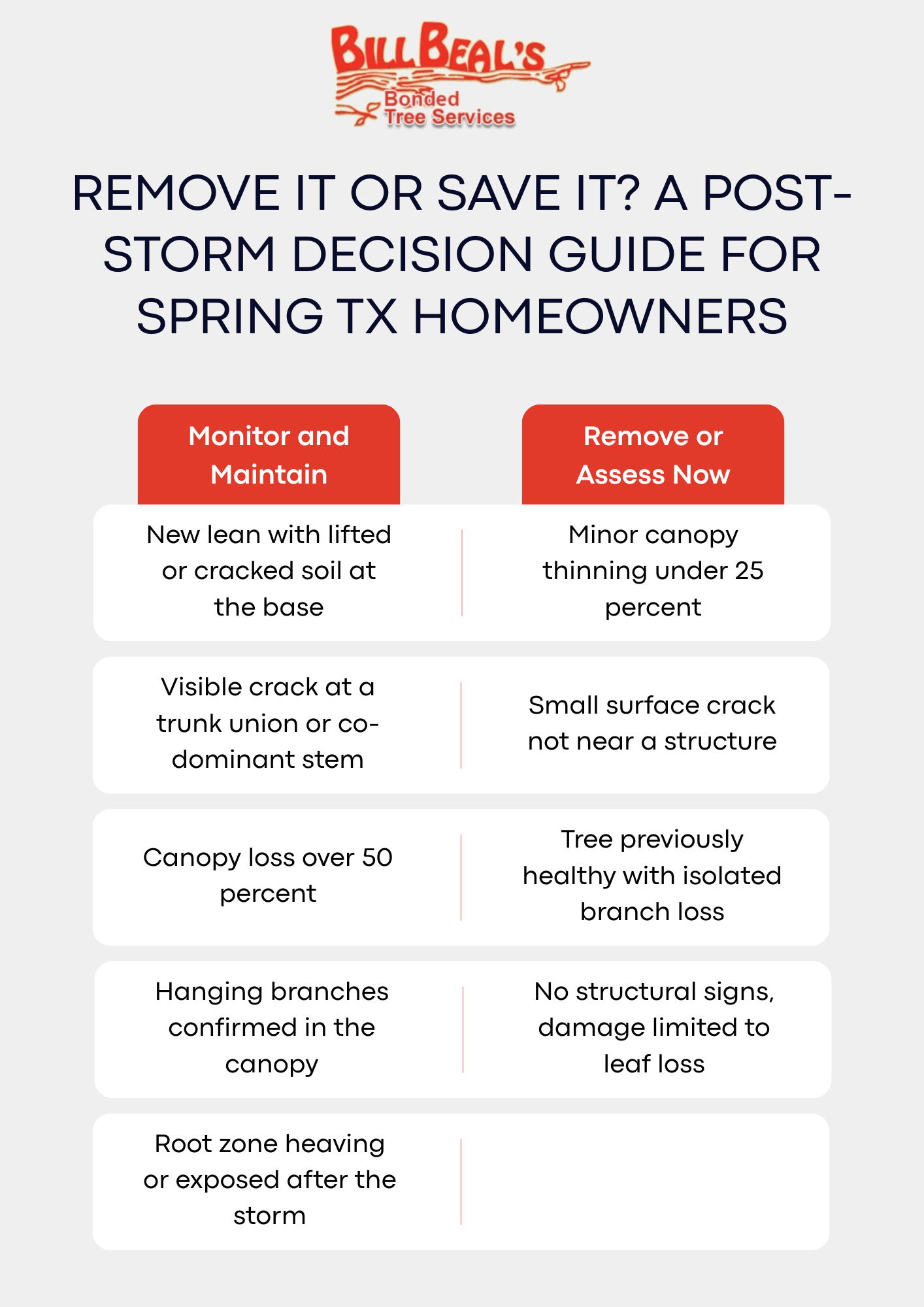
Should the Tree Be Removed or Can It Be Saved?

The honest answer depends on the specific tree, the extent of the damage, and what Harris County's climate has already done to it over time. A general decision framework helps narrow it down before a professional confirms the call.

For a deeper look at which trees in the North Houston area are highest risk during storm events, see 4 Trees You Should Never Ignore After a North Houston Storm.

What Happens If You Wait

The window between noticing a problem and acting on it is where the cost accumulates. A study cited in the PLOS ONE journal on tree failure research found that the likelihood of tree failure expressed in both frequency and financial impact increases annually in the absence of proactive management. Between 1995 and 2007, wind-related tree failures were responsible for 407 deaths across the United States, spread across thunderstorms, non-convective high winds, hurricanes, and tornadoes.


A damaged tree left standing after a storm does not stay in the same condition. Weather, insects, and decay organisms continue working on it. The tree that was a professional-assessment situation in week one becomes an emergency removal situation in week four. Emergency removals cost more and carry higher risk for the crew, the property, and the surrounding structures.


The most expensive tree removal Bill Beal's Bonded Tree Service handles are the ones where the homeowner noticed something after a storm and waited to see what would happen.

Frequently Asked Questions

  • How soon after a storm should I have my trees inspected?

    Within the first week is the practical window for catching problems before they escalate. If any of the five signs above are present, the same day is the right answer. Bill Beal's Bonded Tree Service provides assessments throughout Spring, The Woodlands, Tomball, Cypress, and North Houston following storm events.

  • Can a tree that leaned during a storm be straightened and saved?

    In rare cases, young trees with shallow root plates can be righted and staked if the root ball remained largely intact. Mature trees that shift their lean during a storm have typically sustained root plate damage that makes straightening impractical and the result unstable. A professional assessment will determine what is actually possible.

  • Is a tree with a crack always a removal situation?

    Not always. A surface crack without depth on a branch that is not positioned over a structure may be monitored. Cracks at co-dominant stems, at the trunk base, or on any large limb positioned over a home, vehicle, or area where people gather are removal or at minimum immediate professional assessment situations.

  • What do I do about hanging branches I can see after a storm?

    Stay clear of the area beneath the affected section of canopy. Do not attempt to pull or knock down a hanging branch. Call Bill Beal's Bonded Tree Service. Hanger removal requires rigging, elevated equipment, and an arborist who can work safely above the suspended material. This is not a DIY project regardless of the branch size.

  • Does Bill Beal's Bonded Tree Service offer emergency response after storms?

    Yes. The team provides 24/7 emergency tree removal throughout Spring, TX and surrounding areas. If a tree is on a structure, blocking a driveway, or leaning toward a home after a storm, call (281) 367-4223 directly.

  • How do I know if my tree's root zone is compromised if I cannot see roots?

    Walk the perimeter of the tree and press your foot gently against the soil near the base. Soft, spongy ground, visible soil cracking or heaving on one side, water pooling that has not cleared within two days of the storm, and any mushroom growth at the base are all indicators of root zone issues that warrant a professional look.

Recent Posts

Worker in red helmet trims fallen tree branches on a roof with a chainsaw.
June 30, 2026
Untrimmed trees in The Woodlands TX do not just look overgrown. They damage roofs, foundations, and fences, create legal liability, and produce the exact conditions that make storm damage worse. Bill Beal's Bonded Tree Service explains what is at stake.
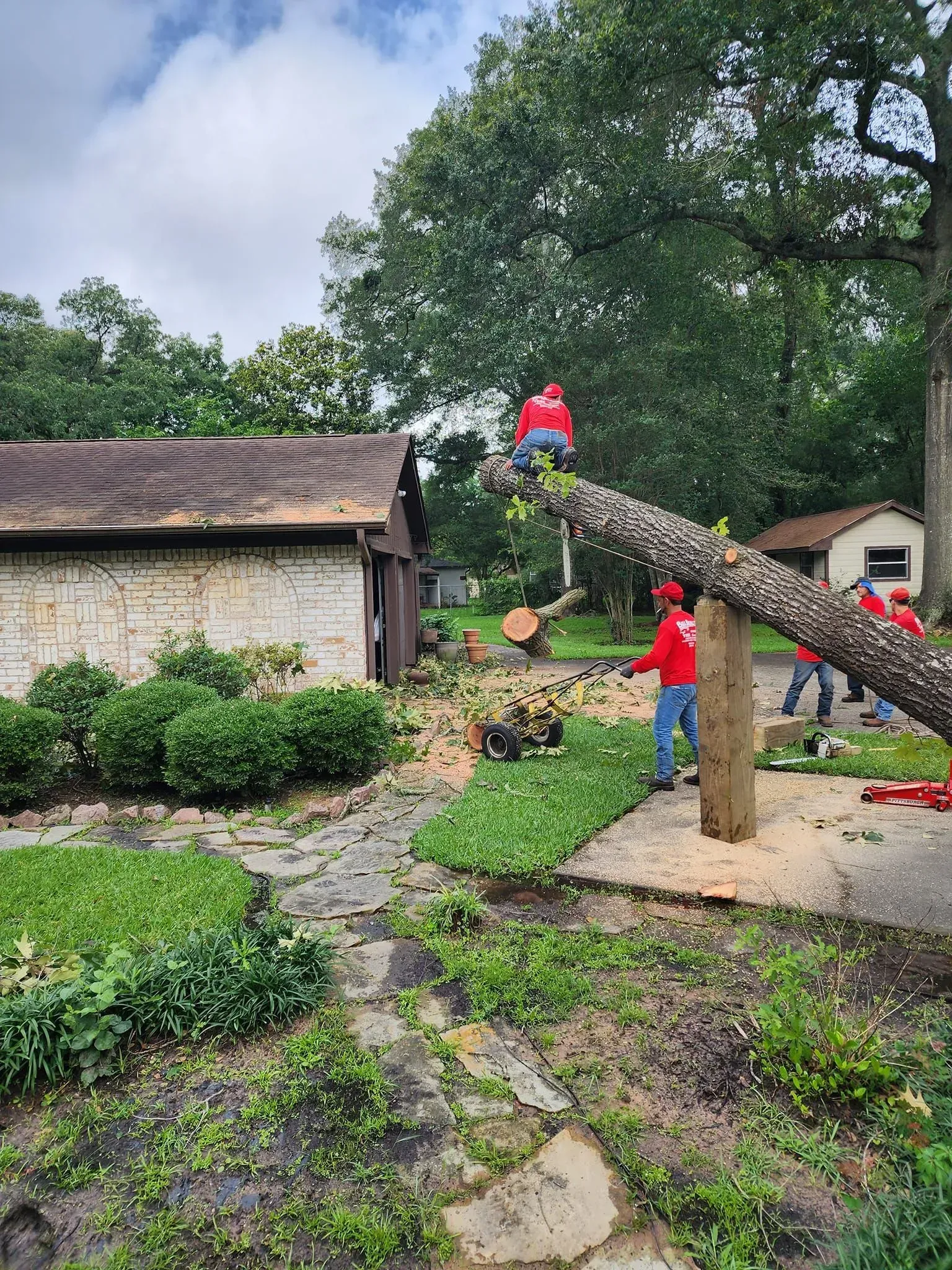
Two workers in red shirts clean a fallen tree beside a stone house and muddy path.
June 16, 2026
Spring TX trees took a beating during Hurricane Beryl in 2024. Bill Beal's Bonded Tree Service explains how to prepare your trees before the next storm and which species in Harris County are highest risk.
Large tree in front of a brick house; people standing on the lawn.
February 18, 2026
Learn why tree fertilization is essential for healthy trees in Spring TX and how professional care protects your property.
Two-story brick house with large tree in front, on a sunny day.
January 21, 2026
Learn when and how to fertilize trees in Spring, TX. Professional tree fertilization improves growth, health, and long-term resilience.
December 16, 2025
Trees Increase Property Value and Curb Appeal
October 28, 2025
Discover which trees pose the greatest risks after severe weather in Spring, TX and surrounding areas. Bill Beal’s Bonded Tree Service provides expert inspections, removals, and storm damage cleanup to keep your property safe.
Logs of varying sizes in a wooded area; some upright as stumps.
October 14, 2025
How to Tell When a Tree Is Structurally Unsafe: Critical Signs Spring, TX Homeowners Need to Know
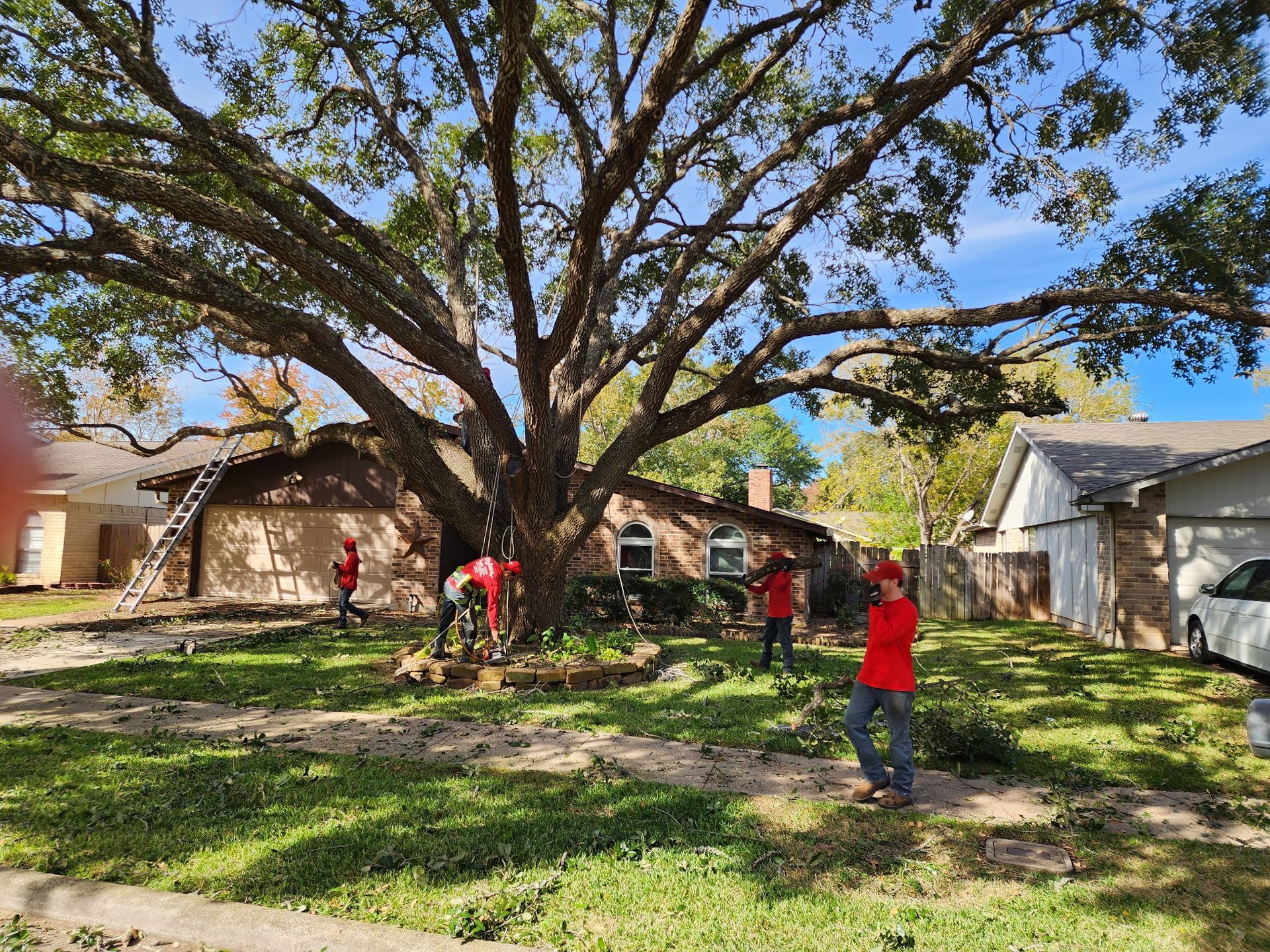
Emergency tree removal crew clearing storm-damaged tree in Spring, TX
October 7, 2025
Bill Beal’s Bonded Tree Service offers 24/7 emergency tree removal in Spring, TX. Safe, fast storm damage cleanup with bonded and insured experts.
Professional arborist trimming branches in Spring, TX neighborhood
September 24, 2025
Trusted in Spring, TX for over 40 years, Bill Beal’s Bonded Tree Service offers safe tree removal, trimming, stump grinding, and palm tree care.
Tree service crew trimming large oak tree near Spring, TX
September 18, 2025
Bill Beal’s Bonded Tree Service provides expert tree removal, trimming, and stump grinding within 40 miles of Spring, TX. Call for a free estimate!