Stump Grinding vs Stump Removal in Spring TX: Which One Actually Solves the Problem

July 28, 2026

Share this article

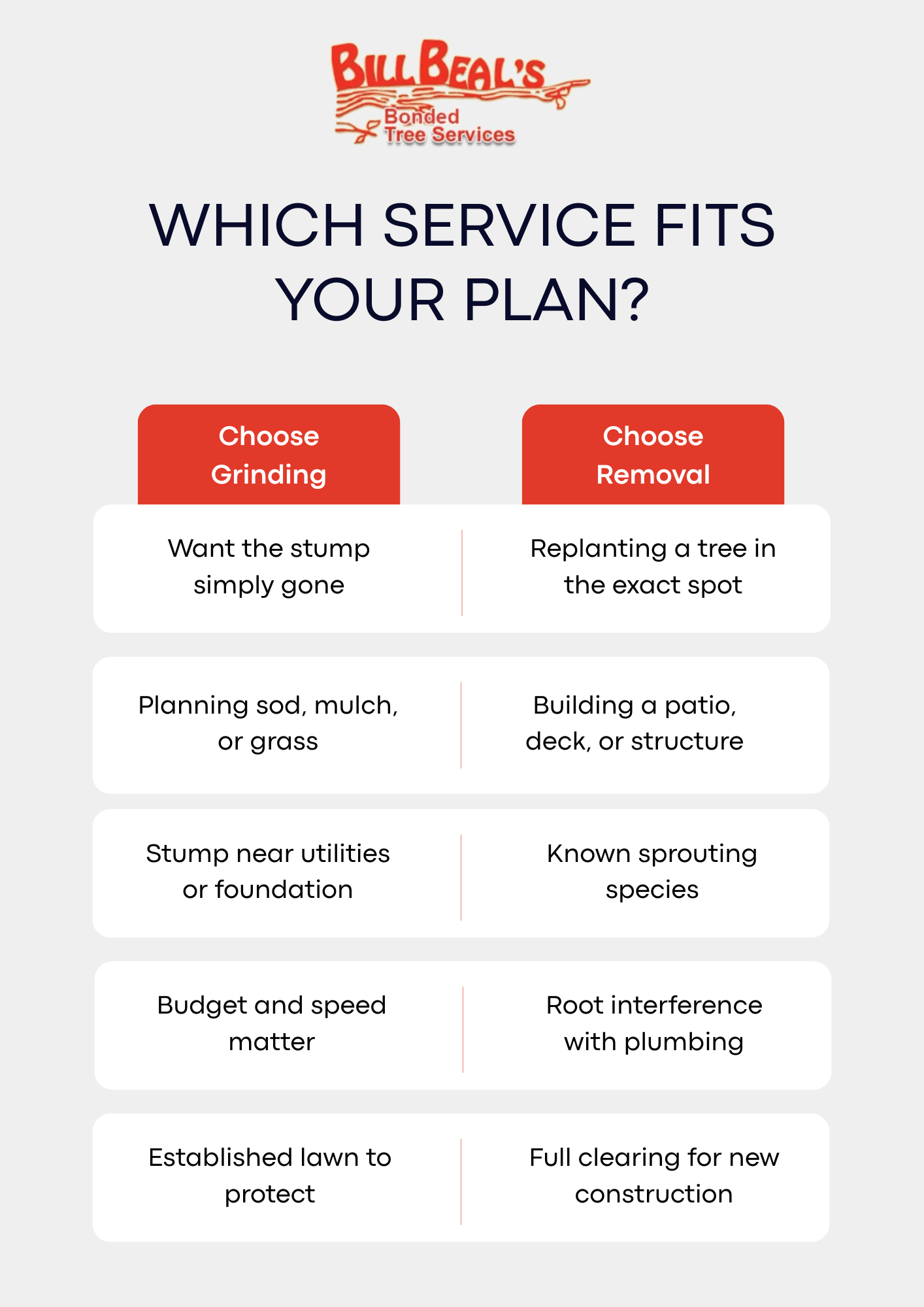
Once a tree comes down on a Spring, The Woodlands, Tomball, or Cypress property, the stump is what is left to deal with, and most homeowners assume there is one way to get rid of it. There are two, they cost different amounts, they leave the yard in very different conditions, and picking the wrong one for the plan means either paying for more than the job needed or being unable to do what you wanted with the space afterward.


Stump grinding and stump removal are not two names for the same service.


Grinding chews the visible stump down below grade and leaves the root system in the ground to decay naturally.


Removal extracts the stump and the root ball entirely, leaving a large open hole. One is faster, cheaper, and handles the vast majority of residential situations. The other is more involved and more expensive, and it is the right call in a specific and predictable set of circumstances.


Bill Beal's Bonded Tree Service has handled stump work across Harris County for over 40 years. This is the honest breakdown of which service actually solves which problem, so the money goes toward what the property actually needs.

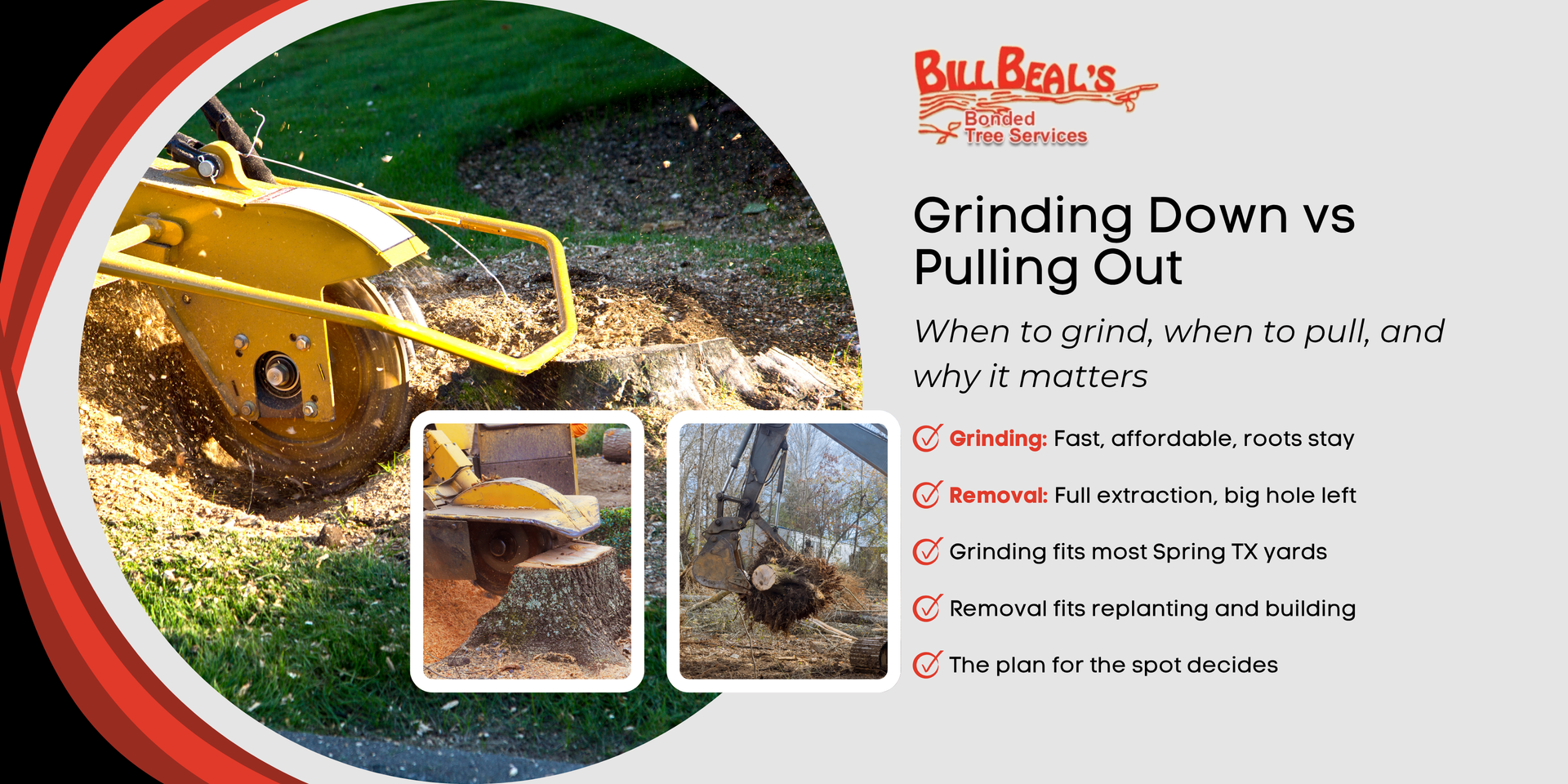
Diagram showing “Grinding Down vs Pulling Out” with a drill on wood and highlighted cut examples.

What Each Service Actually Does

Stump grinding uses a machine with a rotating cutting wheel to chip the stump down into wood fragments, typically 6 to 12 inches below ground level. What is left is a bed of wood chips that settles slightly below grade and the root system, still in the ground, which then decays naturally over the following years.


Stump removal physically extracts the entire stump along with the major root ball, usually with heavy equipment. It leaves nothing behind to decay, and it leaves a large open hole that has to be backfilled and restored.


The single most important difference between the two is what happens to the roots:


  • Grinding leaves the roots in the ground. They decay on their own over three to seven years depending on species and soil conditions.
  • Removal pulls the major roots out. It takes 70 to 80 percent of the structural root system with the stump.
  • That difference drives everything else: cost, yard disruption, replant options, and how the space can be used afterward.

The Head-to-Head Comparison

Factor Stump Grinding Stump Removal
Cost Lower Higher, more labor and equipment
Speed 30 minutes to 2 hours per stump Several hours, complex jobs longer
Roots Left to decay in place Major root ball extracted
Yard disruption Minimal, contained to the stump Significant, large hole and surrounding area
What is left Bed of wood chips near grade Open hole to backfill
Replanting same spot Not ideal, roots and chips remain Well suited once backfilled
Building over the spot Not recommended Appropriate

The honest read for a Spring-area property:


  • Grinding solves the problem for most homeowners who want the stump gone, the trip hazard eliminated, and the yard usable again
  • Removal is the right call when the plan for that exact spot requires clear soil, replanting, or construction
  • Neither is a compromise when it is matched to the actual goal for the space

Why Grinding Fits Most Spring TX Properties

For the large majority of residential stump jobs across Spring, The Woodlands, Tomball, and Cypress, grinding is the practical answer, and the reasons hold up under Harris County conditions specifically.


It handles the actual goal. Most homeowners want the same things: the stump gone, no trip hazard, no eyesore, and the ability to lay sod, mulch, or landscape over the spot. Grinding delivers all of that without the cost and disruption of full extraction.


It protects the surrounding yard. Harris County's heavy clay soil makes full extraction messier than it is in sandy soils. Pulling a root ball out of dense clay disturbs a large area around the stump. Grinding stays contained to the stump footprint, which matters on established lawns and near landscaping, patios, and irrigation.


It avoids underground surprises. Full removal near a house, driveway, or utility runs risks disturbing what is underground. Grinding works at a controlled depth without excavating the surrounding soil, which is safer around the utility lines, sprinkler systems, and foundations common on developed Spring-area lots.


It is faster and less expensive. A typical grind is done in under two hours and costs meaningfully less than extraction. For a homeowner who simply wants the stump handled, that is the efficient path.


The main thing grinding does not do is clear the soil for replanting or building, and that is where removal earns its place.

When Removal Is the Right Call

An honest comparison names the situations where paying more for full removal is the correct decision, because they come up regularly on Spring-area properties.


  • Replanting in the same spot. Grinding leaves roots and nitrogen-depleting wood chips in the soil, which stress a new tree. If a new tree is going exactly where the old one stood, removal gives it clean soil to establish in.
  • Building over the location. Patios, decks, sheds, additions, and other structures need stable, cleared ground. Decaying roots and settling soil under a slab create problems. Removal clears the footprint properly.
  • Sprouting species. Some trees send up new shoots from roots left behind after grinding. On species prone to suckering, extraction eliminates the regrowth problem that grinding can leave behind.
  • Roots threatening plumbing or hardscape. When the root system is already interfering with underground lines, a driveway, or a foundation, removing the roots addresses the cause rather than leaving it to keep working underground.
  • Full lot clearing. On a property being cleared for development or major landscaping, extraction gives a genuinely clean slate.


Outside of situations like these, grinding usually accomplishes what the homeowner actually wants at lower cost and with less disruption.

The Pest and Regrowth Question Every Spring Homeowner Should Ask

Two concerns come up often enough on Harris County properties that they deserve a direct answer.


Decaying roots and pests. Roots left in the ground after grinding decay over several years, and decaying wood can attract termites, carpenter ants, and fungi. On most properties this is not a significant issue, since the roots are dispersed and below grade. But on a lot already dealing with termite pressure, or where the stump is close to the house, the decaying root mass is worth weighing. In those cases, removal reduces the underground wood that pests are drawn to.


Regrowth from leftover roots. Certain species sprout new shoots from roots that survive grinding. When those shoots appear, they have to be managed until the root energy is exhausted. For homeowners who do not want to deal with that follow-up, extraction on a sprouting species settles it in one step. Bill Beal's Bonded Tree Service identifies the species and flags regrowth potential during the assessment so the choice is made with that information rather than discovered afterward.


For properties where the stump is one piece of a larger tree or land project, the land clearing and forestry mulching services cover full-property work, and homeowners still deciding on scope can start with an on-site evaluation through the contact page.

What a Stump Job Looks Like With Bill Beal's Bonded Tree Service

Every stump job starts with a look at two things: the stump itself and what the homeowner wants that spot to become.

Phase What happens
Assessment Stump size, species, location, and utility proximity checked
Plan review What the spot will be used for afterward
Recommendation Grinding or removal, with honest reasoning
The work Grinding below grade, or full extraction per the plan
Cleanup Chips removed or repurposed, hole backfilled if removal
Site finish Area leveled and left ready for the next step

The recommendation always follows the property and the plan rather than defaulting to the more expensive service. If grinding solves the problem, that is what gets recommended. If the homeowner's plan for the spot genuinely requires extraction, that reasoning is explained before any work is scheduled.

Frequently Asked Questions

  • How deep does stump grinding go in Spring TX?

    Standard grinding takes the stump down 6 to 12 inches below grade, which is enough to eliminate the trip hazard and lay sod, grass, or mulch over the spot. If the plan is to replant or lay sod, the crew grinds deeper so there is room for clean topsoil above the chips. Telling the crew what is going in that spot lets them grind to match the plan.

  • Can I plant a new tree where the old stump was ground down?

    Not directly into the fresh chips. Grinding leaves wood chips and root material that tie up soil nitrogen and stress a young plant. If replanting in the exact spot is the goal, full removal is usually the better choice because it gives the new tree clean soil. If grinding was already done, the planting area needs the chips replaced with quality topsoil first.

  • Will the stump grow back after grinding?

    The tree itself is dead once the stump is ground, so it will not regrow as a tree. However, a handful of species can send up shoots from the roots left behind. On those species, or anywhere regrowth would be a problem, removal is the surer choice. Bill Beal's identifies the species during the assessment and flags whether sprouting is a concern.

  • How much does stump grinding cost compared to removal in Harris County?

    Grinding is consistently less expensive because it is faster and uses less equipment, typically completed in under two hours per stump. Removal costs more because of the labor, heavy equipment, and site restoration involved in extracting the root ball and backfilling the hole. Bill Beal's provides on-site assessments and honest quotes so the price reflects the actual stump and the chosen service.

  • Do the roots left after grinding cause problems?

    For most properties, no. The roots decay naturally over three to seven years without issue. The situations to weigh are a lot with existing termite pressure, a stump very close to the house, or roots already interfering with plumbing or hardscape. In those cases, removal addresses the underground root mass that grinding leaves behind.

  • Does Bill Beal's handle stump work in The Woodlands, Tomball, and Cypress as well as Spring?

    Yes. Bill Beal's Bonded Tree Service provides stump grinding and stump removal throughout Spring, The Woodlands, Tomball, Cypress, and the surrounding Harris County communities. Every job starts with an on-site assessment of the stump and the plan for the space.

Recent Posts

People in red shirts working in a muddy, tree-filled park with a backhoe and flags nearby
July 14, 2026
Learn five warning signs a tree may be unsafe after a storm and when Spring, TX homeowners should call for a professional inspection.
Worker in red helmet clearing fallen tree limbs from a roof with a chainsaw and ladder nearby
June 30, 2026
Learn how untrimmed trees in The Woodlands, TX can damage property, increase storm risks, and create costly safety and liability issues.
Person in red shirt cuts a fallen tree in a muddy yard beside a small house.
June 16, 2026
Learn how to prepare trees for hurricane season in Spring, TX and discover which Harris County tree species face the highest storm risk.
Tree-shaded courtyard with a tan building and a few people standing near the left side.
February 18, 2026
Learn why tree fertilization is essential for healthy trees in Spring TX and how professional care protects your property.
Brick two-story suburban house with large front yard and a tree shading the facade
January 21, 2026
Learn when and how to fertilize trees in Spring, TX. Professional tree fertilization improves growth, health, and long-term resilience.
Red-shirted person standing on a sidewalk in front of a brick house with a garage and trees.
December 16, 2025
Discover how tree planting boosts property value, improves curb appeal, provides shade, and supports a healthier landscape in Spring, TX.
Tall tree in a sunny green field with a dirt path curving past it and a farmhouse in the distance.
October 28, 2025
Learn which trees pose the greatest risks after severe storms in Spring, TX and how expert inspections and removal help protect your property.
Cut tree stumps and logs in a woodland clearing with dry grass and a blurred background
October 14, 2025
How to Tell When a Tree Is Structurally Unsafe: Critical Signs Spring, TX Homeowners Need to Know
Children playing under a large tree in a sunny yard beside houses
October 7, 2025
Bill Beal’s Bonded Tree Service offers 24/7 emergency tree removal in Spring, TX. Safe, fast storm damage cleanup with bonded and insured experts.
Lone tree on a dry hillside beneath a bright blue sky with wispy clouds
September 24, 2025
Trusted in Spring, TX for over 40 years, Bill Beal’s Bonded Tree Service offers safe tree removal, trimming, stump grinding, and palm tree care.
Show More